
Tested first-hand

Best Jeopardy Game Makers in 2026: I Tested 5 and Here's What Actually Happened

Five Jeopardy game makers, one real board attempted on each, on the free tier, in September 2026. Timed results, real limits, and where my own product loses.

KJ
KJ, Founder of Kleveroo
By KJ, Founder of Kleveroo · Tested September 2026 · Updated

Disclosure first: I built one of the tools in this comparison. Kleveroo is mine. I've ranked it second rather than first, and I've been specific enough about every other tool that you can go check my work. In three places below I tell you to use something other than my own product.

Jeopardy-style game show set with a large category board and contestant podiums
Contents

Short answer

After testing five of the best-known Jeopardy game makers, JeopardyLabs is the right pick for most people — it's free, needs no account, keeps team scores for you, and has an enormous library of games somebody else already built. Choose Kleveroo when you want to move from a topic or a lesson plan to a polished, themed game without manually entering every clue. Factile is the pick when phone buzzers are the point.

One thing worth clearing up early, because a lot of comparisons get it wrong: both JeopardyLabs and Kleveroo have a built-in team scoreboard, and in both the host awards the points. Scoring is not the separator. What separates them is how fast a board gets written, whether you can hand the tool a topic or a lesson file, and how the finished board looks on the screen.

The thing that separates these tools isn't the length of their feature lists. It's how fast you get from "I need a game" to a playable board in front of a group. That's what I tested, and it's the only metric that ever mattered to me as a user.

Why I'm the one writing this

I've run remote sales teams since 2020. We had a roundup every weekday at lunch, and at some point I started building Jeopardy-style boards for my reps. It worked better than anything else I tried. People who never spoke up in meetings turned into category specialists, and I'd sometimes build a category around a new hire just so they could be the hero of a round.

I built those games in JeopardyLabs. I liked it enough to pay for the $20 lifetime upgrade so I could make bigger boards, and I'd pay it again.

Then the math caught up with me. My team wanted something fresh constantly, and each board took me somewhere between 35 minutes and an hour to write and enter. Several boards a week, on top of actually running a sales team, is a real second job. Eventually I stopped making them as often — not because JeopardyLabs was bad, but because the format was expensive to feed. The game worked fine. Producing enough content to keep it running was the problem.

That's what led me to build Kleveroo. So when I judge these tools on time-to-a-playable-board, that isn't a metric I invented for an article. It's the specific thing that broke my own setup.

How I tested

I created a real board, or tried to, on every tool below, on the free tier unless noted, in September 2026. Where a tool published a claim about itself — a price, a limit, a generation time — I checked it against what actually happened and noted where the two disagreed.

What I was looking at: how fast I could reach a playable board, what the free tier genuinely allows, how much account creation is required before you can evaluate anything, whether the result works as a host-led game in a real room, and how team scoring and AI creation are handled.

Two things upfront. I couldn't evaluate TriviaMaker as thoroughly as the rest, because most of it sits behind an account — I've said so in its section rather than dressing up a guess as a review. And I've left out Buzzinga, which appears on most lists like this one, because I haven't run a real session on it. Five tools I actually used beats six where one is invented.

The 5 Jeopardy game makers at a glance

Everything below is what I saw on the free tier in September 2026. Plans change — check the tool before you commit an evening to it.

Five Jeopardy game makers compared by free tier, AI generation, team scoring, board themes and what each one is best at
ToolFree tierAI generationTeam scoringBoard themesBest at
1. JeopardyLabsUnlimited boards, no accountNoBuilt-in team scoreboard; host awards pointsOne standard board style; custom colors need manual HTML/CSS editsServing the most people with the least friction
2. Kleveroo (mine)Unlimited manual boards, 2 AI generationsYes, paidBuilt-in team scoreboard; host awards points during playMultiple selectable board themesGetting from a topic or lesson to a themed, hosted board fast
3. Factile3 games total, per accountYes, paid plansBuilt-in scoring with buzz-inSelectable templates and team charactersPhone buzzers in a live classroom
4. TriviaMakerLimited; account needed to see muchYesBuilt-in scoringMultiple formats and stylesSeveral game-show formats in one subscription
5. SoonLab200 credits, which bought me one gameYes — it's the whole productSingle score in what I generatedWhatever the generation producesBuilding a custom browser game from a prompt

Swipe the table sideways to see every column.

Want to skip the manual entry?

Build a board free by hand, or let the AI generator draft the grid and edit from there.

01 / 05

JeopardyLabs — the most useful tool here for the most people

JeopardyLabs asks nothing of you. No account, no email, no trial. You open it, you build a board, you host it. That single decision is why it's ranked first: it removes every step between deciding you want a game and having one.

The library is the other half of it. Hundreds of thousands of boards other people already made, searchable, and copyable into your own version. For a huge number of teachers, the fastest path to a Jeopardy game is finding one that already exists on roughly the right topic and editing four clues.

JeopardyLabs board builder with categories and point values
JeopardyLabs board builder

What it is, precisely, is a question-and-answer board with a scoreboard attached. It shows the grid, it reveals the clue, and it gets out of the way. The scoreboard is built in and better than people give it credit for: you name each team, and the host adds or subtracts points with plus and minus controls as the round goes. The host decides who was right — the tool tracks the tally. For plenty of rooms that's exactly right.

I paid the $20 lifetime membership so I could build bigger boards, and I'd pay it again. That's not a hedge — it's the only tool in this comparison I've spent my own money on before I had a reason to write about any of them.

Where it loses: every board is written by hand, and every board looks like every other board. There's one standard board style, and its own FAQ says changing the colors means downloading the game and editing the HTML and CSS yourself — possible, but not something most hosts are going to do on a Tuesday. If you run a game once a month, none of that matters. If you run one twice a week, the manual entry is the thing that eventually stops you — that's exactly what happened to me.

Use it if: you need a board today, you don't want an account, you're happy writing the clues yourself, or somebody has probably already made the board you need. Kleveroo vs JeopardyLabs, compared.
02 / 05

Kleveroo — mine, and here's where it loses

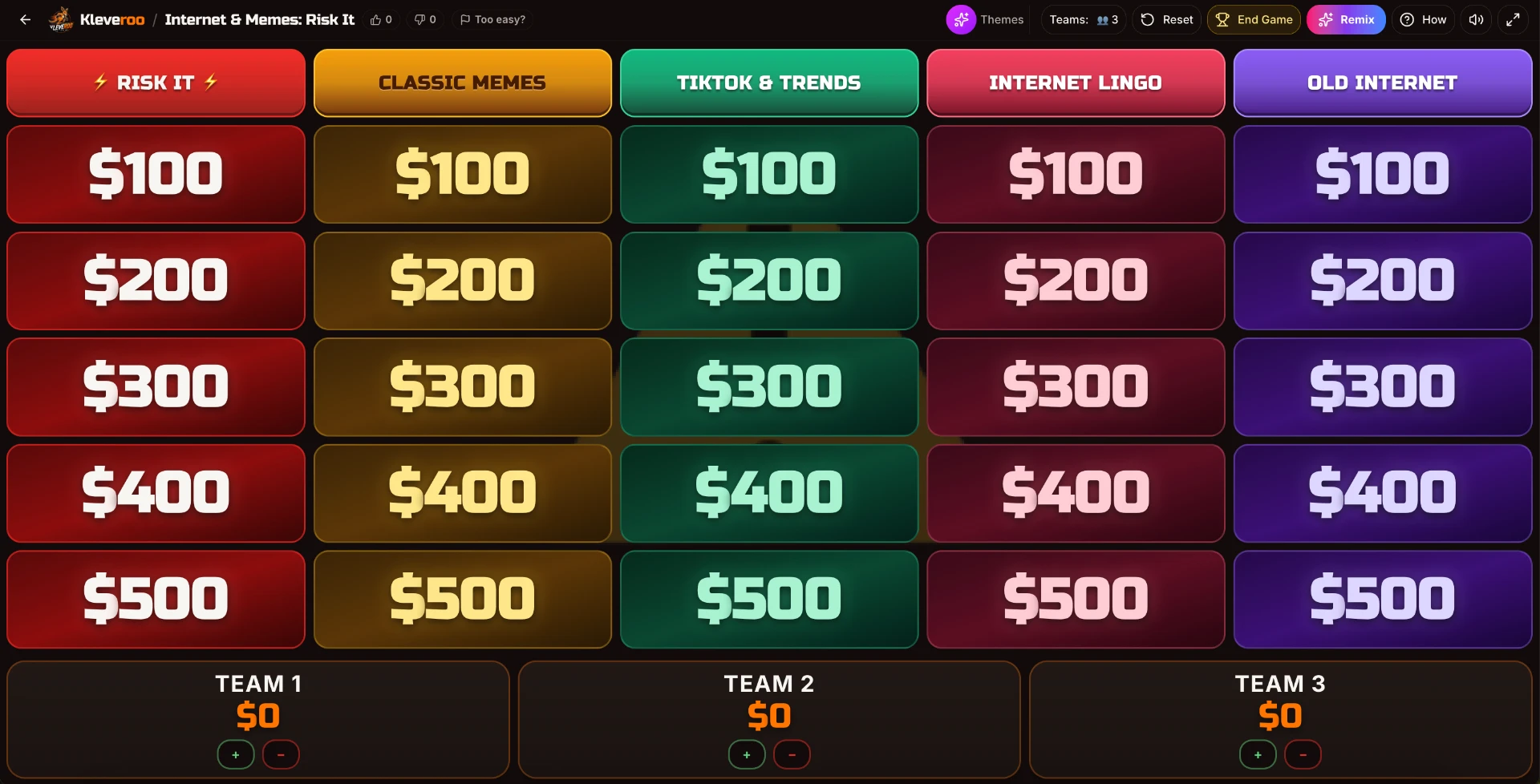
Kleveroo's Board Battle is host-led on a shared screen. One projector, TV or screen share; the host taps a tile, reads the clue, awards the points, and the tool handles the team scoreboard, the timer and marking played tiles so nothing gets repeated. Nobody needs a phone. Nobody joins a code. That scoring model is close to how JeopardyLabs works, and I'm not going to pretend it's the reason to switch — the reasons are below.

That was a deliberate choice, and it came straight out of running sales teams. Every time I asked ten adults to pull out their phones and join a room code, I lost two minutes and about half the energy in the call. Removing player devices removed the failure point.

Kleveroo Board Battle shared-screen Jeopardy-style board with built-in team scoring
Kleveroo Board Battle host view
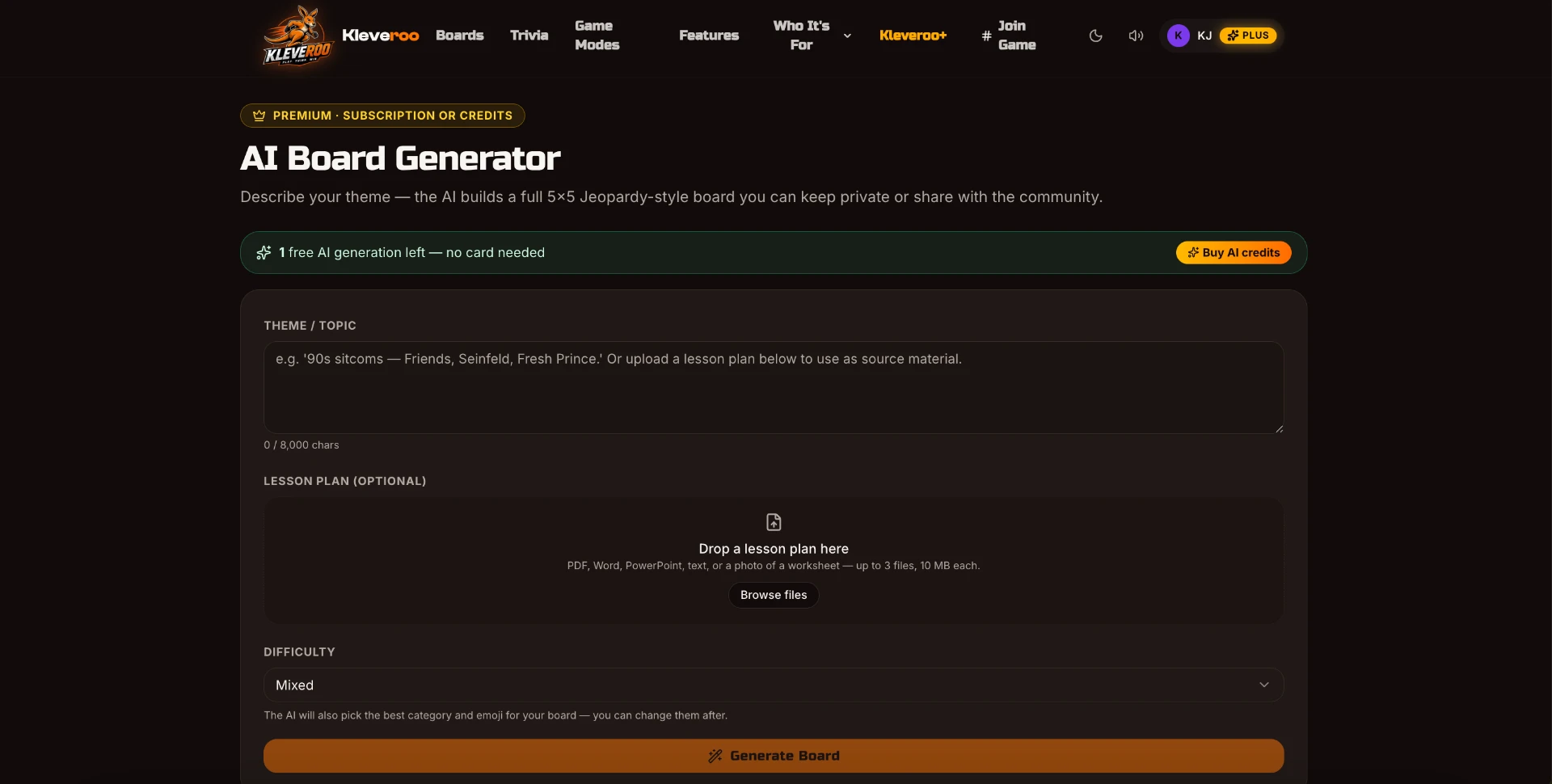
Kleveroo AI Jeopardy board generator drafting a board from a topic or lesson material
Kleveroo AI board generator

The real difference is creation speed, which is the problem I originally had. There are three ways to fill a board. You can build it by hand, free and unlimited, the same way I used to. You can hand the AI board generator a plain-language topic — "seventh grade cell biology," "our Q3 product launch" — or upload the lesson material itself, a worksheet or a lesson plan, and let it draft the grid from your own content. Or you can import a CSV, including one you had ChatGPT write for you, and skip typing entirely.

Under normal conditions any of those last two gets you a playable, fully editable board in about two minutes. I'm not going to promise under two minutes, and I'm not going to pretend every draft comes back perfect — the AI misjudges difficulty sometimes and occasionally writes a clue that gives away its own answer. Every tile stays editable, so you fix the two that are wrong instead of writing all twenty-five. And unlike a single-style board, you pick a theme for the finished game, so a sales kickoff doesn't have to look like a fourth-grade review round.

Pricing, precisely: manual building is free and unlimited. New accounts get 2 one-time AI board generations after email verification. After those, AI generation runs on a monthly allotment — $4.99/month for 10 AI boards or $9.99/month for 15 — plus credit packs that run from $0.60 down to $0.35 per board, and credits do not expire. CSV import is different: it doesn't burn an AI credit at all, it's access included with either paid plan, so you can import as many prepared boards as you like. If you only ever build by hand, you never pay anything.

Where it loses: library depth, badly. JeopardyLabs has years of community boards and Kleveroo's library is still growing. If your win condition is "find a board somebody already wrote on my exact topic," go use JeopardyLabs. And Board Battle has no mobile buzzers — that's not a gap I'm planning to close, it's the design. If buzz-in is the point, use Factile.

Use it if: you want to move from a topic or a lesson plan to a polished, themed game without manually entering every clue. Build one free, or see the classroom setup.

03 / 05

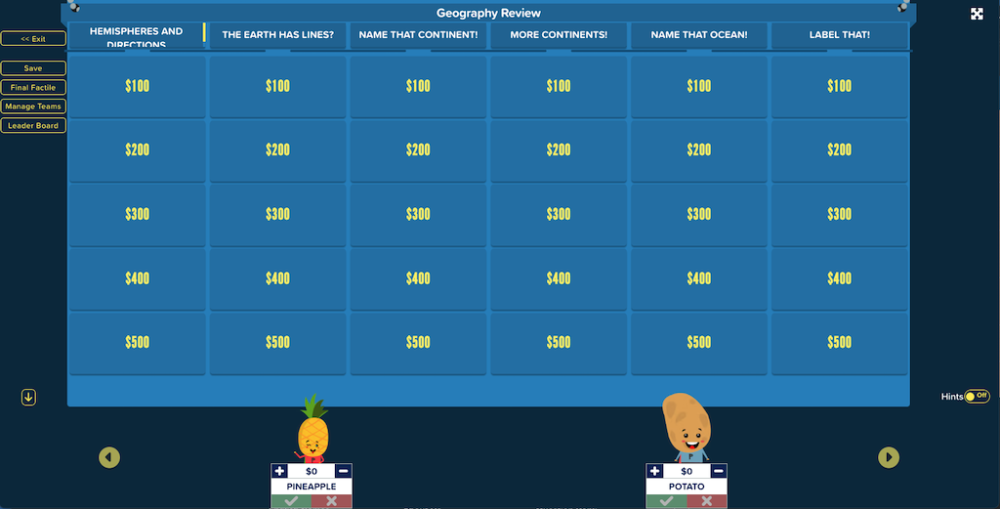
Factile — the buzzer tool, with a free tier worth understanding first

Factile is the answer when the buzz-in moment is the game. Students pull up the join screen on their phones, the host sees who buzzed first, and the room gets the game-show tension that a host-led board deliberately trades away. It's a mature product with a large install base and multiple play modes, plus media support and AI drafting on paid plans.

Factile Jeopardy-style game board interface
Factile game board

The free tier is the part people misread. It's 3 games total per account, not 3 per month. You can evaluate it properly, but you can't quietly run a free classroom on it all year — plan on paying if it becomes your regular tool.

To me, Factile's styling feels heavily geared toward elementary classrooms — mascots, bright colors, a lot of playfulness. That's a fit issue, not a quality issue. In a fourth-grade room it lands perfectly; in a sales kickoff it's a harder sell. And the team-character idea is genuinely good — giving each team an avatar does more for engagement than it has any right to, and I'll give them full credit for it.

Use it if: students buzzing from phones is the deciding feature. Kleveroo vs Factile, compared.

04 / 05

TriviaMaker — I couldn't properly evaluate it, and that's the finding

TriviaMaker's pitch is breadth: several game-show formats — grid, wheel, list-style rounds — in one subscription, rather than one board type done deeply. If you host varied events and want the formats to rotate, that's a real argument.

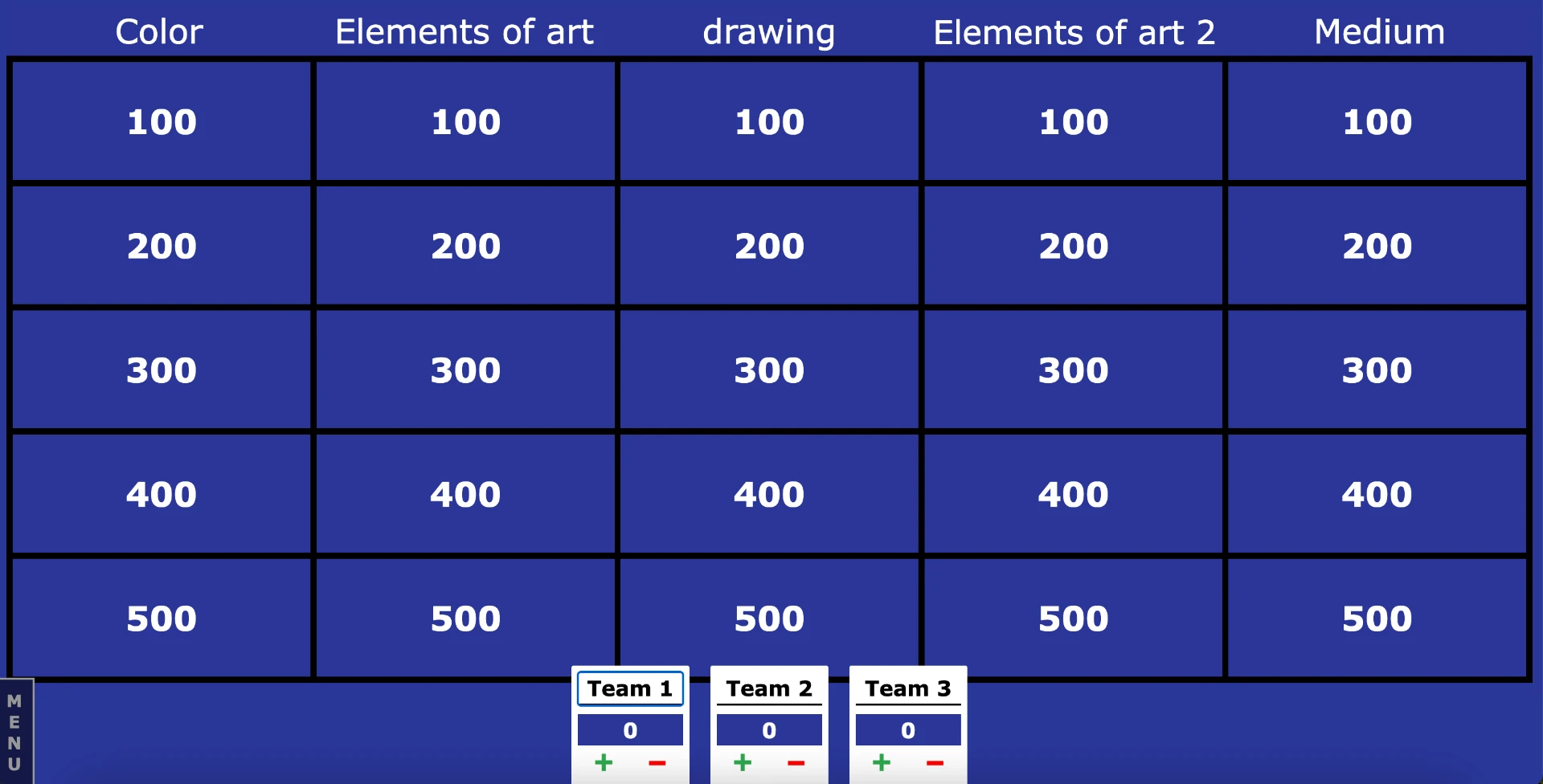
TriviaMaker game show style board
TriviaMaker board

But most of the experience sits behind account creation. I couldn't get far enough without signing up and committing to evaluate it the way I evaluated the others, and I'm not going to write a confident verdict I didn't earn. That's the finding in itself: if you can't try the product before you register, you're evaluating marketing copy.

Use it if: you already know you want multiple game-show formats under one subscription and you're willing to create an account to look around.

05 / 05

SoonLab — impressive software that didn't behave like a Jeopardy game maker in my test

SoonLab deserves the longest section here, because I actually ran a full generation and the result was interesting rather than bad. The site looks great and the output it produced was genuinely polished software.

The friction started before generation. I typed my prompt, was asked to sign up, and the prompt disappeared during signup — I had to retype it. Signing up granted 200 credits, which bought exactly one generation attempt. Paid plans run $9.99/month for 15 generations, $19.99 for 45, and $49.99 for 125.

I timed it. On September 9, 2026, the generation took 53 minutes and 46 seconds. For most of the back half it sat at 99% with the message Finalizing bundle and deploying to execution context, while the execution log kept scrolling, so it clearly hadn't hung — it just took that long.

The finished result looked like Jeopardy and did not function like it. It was a single-player typed-answer riddle game: one score rather than teams, and a hint-for-half-reward mechanic instead of a host revealing an answer. The categories it produced were Double Meanings, Sequence Lab, Logic Box, The Side Door, and Letter Lights. Fun, genuinely — but not a board I could host for a room.

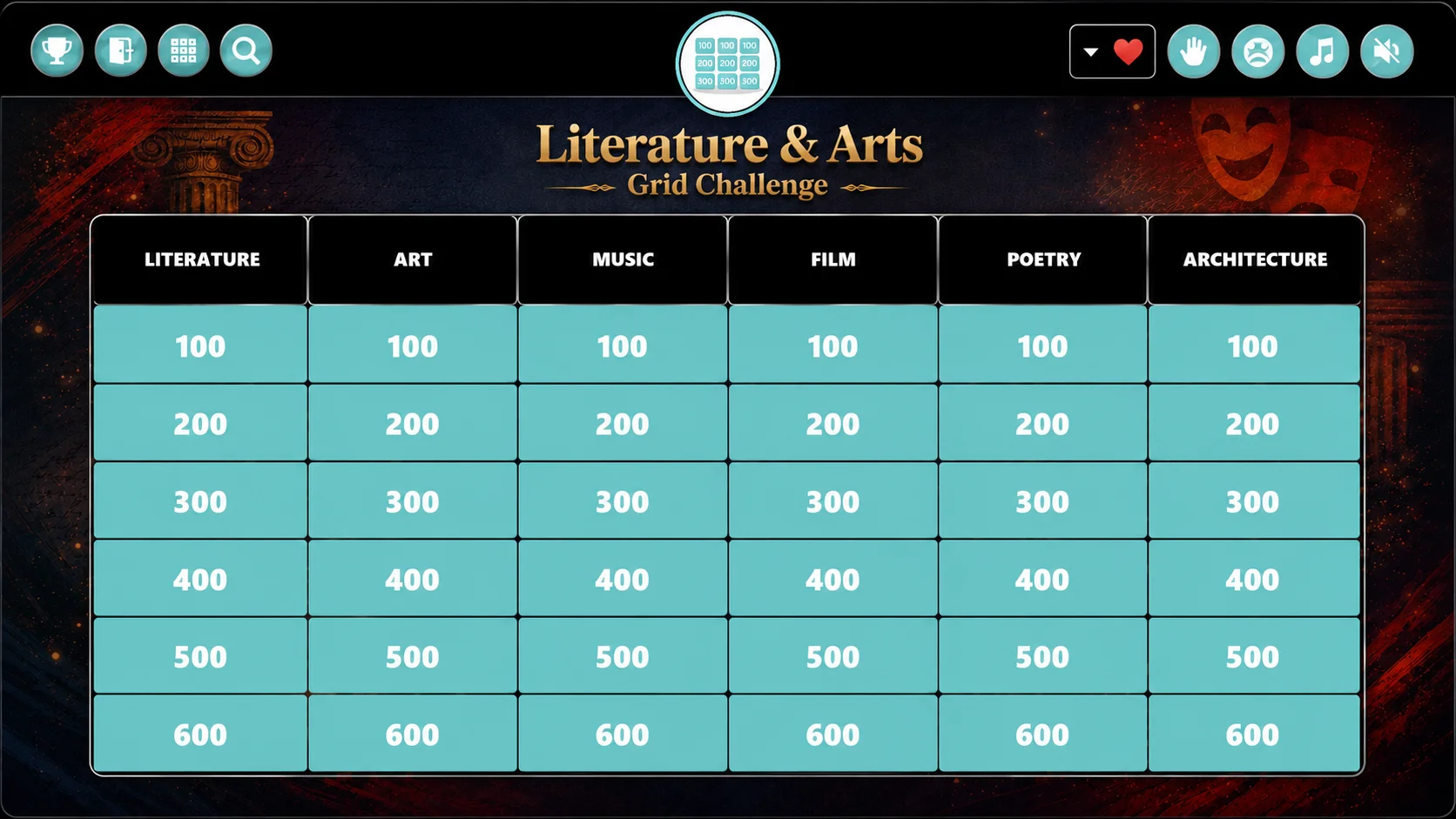
SoonLab AI-generated Jeopardy-style game board
SoonLab generated board

In fairness to SoonLab: I used the word "riddle" in my prompt, and that may well have pushed the whole thing toward puzzle mechanics. Their own demo prompt is around 400 words and reads like a detailed specification, not a request — this is a tool that rewards writing a spec, and I gave it a sentence.

One more data point. On September 9, 2026 I searched SoonLab's public game library for "Jeopardy" with no filters applied and got no results. The visible category tabs were Action, Puzzle, RPG, Eliminate, Simulation, Strategy, and Sports.

Fair conclusion: SoonLab is not a bad product. It solves a different problem — building a custom browser game from a prompt — and it's impressive at that. It just isn't a Jeopardy game maker, and I wouldn't reach for it an hour before a class.

Which one should you use?

You need a board this afternoon and don't want an account
JeopardyLabs
Students buzzing in from their phones
Factile
Going from a topic or a lesson plan to a themed, timed board without typing 25 clues
Kleveroo
Constant board creation where manual entry is the bottleneck
AI-assisted creation or CSV import — Kleveroo, or Factile on a paid plan
A custom browser game rather than a hosted board
SoonLab

None of these tools is bad. They're solving adjacent problems and the labels on the box make them look more alike than they are.

The expensive mistake isn't picking the second-best tool. It's spending an evening in a tool that solves the wrong problem — writing 25 clues into a builder that turns out not to do the one thing your room needs.

So don't take my ranking on faith. Pick the one that matches your situation above, build one real board, and run one real round with actual people. You'll know inside ten minutes.

Start with one real board

Free and unlimited to build by hand — or start from a topic, a lesson file or a CSV and pick a theme.

Go deeper on a specific tool

Head-to-head breakdowns and alternative round-ups from the Kleveroo library.

Frequently asked questions

+What is the best Jeopardy game maker?

For most people, JeopardyLabs. It is free, needs no account, has a built-in team scoreboard, and has an enormous library of boards somebody else already built. Choose Kleveroo when you want to move from a topic or lesson plan to a polished, themed game without manually entering every clue. Factile is the pick when phone buzzers are the point.

+Is there a genuinely free Jeopardy game maker?

JeopardyLabs is free with unlimited boards and no account at all. Kleveroo's manual builder is free and unlimited too, and new accounts get 2 one-time AI board generations after email verification. Beyond those, AI generation uses credits from a monthly allotment; CSV import doesn't use credits at all — it's included with either paid plan. Factile's free tier is capped at 3 games total per account, not 3 per month.

+What is the best Jeopardy game maker for teachers?

If students should buzz in from their phones, Factile. If you need a board this afternoon with no signup and are happy writing the clues yourself, JeopardyLabs. If the bottleneck is producing boards — and you want to go from a topic or an uploaded lesson to a themed, timed board — Kleveroo.

+Can I make a Jeopardy game with AI?

Yes. Kleveroo drafts an editable 5x5 board from a plain-language topic or your own uploaded lesson material and you can host it straight away; AI generation is a paid feature after the 2 one-time generations new accounts get. Factile offers AI drafting on paid plans. JeopardyLabs has no AI generation — every board is written by hand.

+Do these tools keep score for you?

JeopardyLabs and Kleveroo both have a built-in team scoreboard where the host awards points — you name the teams and adjust their scores as you play. Scoring is not what separates them. The differences are creation speed, AI drafting, lesson upload, CSV import, selectable board themes and the timer.

+How long does it take to make a Jeopardy board by hand?

In my own use, 35 minutes to an hour per board in JeopardyLabs — writing 25 clues and answers and typing them in. That is fine occasionally and unsustainable several times a week, which is the whole reason AI-assisted creation exists. With Kleveroo's AI generation or a CSV import, the same board is usually about two minutes away, then you edit what the draft got wrong.

+Does Kleveroo have mobile buzzers?

No. Board Battle is deliberately host-led on one shared screen with no player devices. If buzz-in from phones is the deciding feature, Factile is the better choice.

+Is SoonLab a Jeopardy game maker?

Not in my test. It is an AI game generator that can produce something Jeopardy-shaped, but the board it built for me played as a single-player typed-answer puzzle game with one score. Its public library returned no results for a Jeopardy search in September 2026.

+Which Jeopardy game maker needs no account?

JeopardyLabs. You can build and host without signing up. Every other tool in this comparison expects an account before you can meaningfully evaluate it, and TriviaMaker in particular hides most of the experience behind signup.

Build one real board and run one real round

Free manual builder, or start from a topic, a lesson file or a CSV. That's the only way to know if a tool fits your room.

Jeopardy! is a registered trademark of Jeopardy Productions, Inc. Kleveroo is not affiliated with or endorsed by Jeopardy Productions, Inc., Sony Pictures Television, or any related entity. All third-party product names, logos, and brands referenced on this page are property of their respective owners and are used for identification and comparison purposes only.