
Baamboozle is built around something a lot of classroom game platforms don't attempt: a genuine game that works with one screen, one teacher, and no student devices. That design choice is why switching away is less obvious than it looks.
Most alternatives compete on features Baamboozle doesn't have, while changing the thing it does well. So the useful question isn't which tool has more, it's which tradeoff you're willing to make.
The short answer
- You want a structured game-show board with categories and point values: Kleveroo or JeopardyLabs
- You want buzz-in and formal rounds: Factile
- You want a free tier with no ads and no account: JeopardyLabs
- You want fast whole-class rounds and the free tier covers you: stay on Baamboozle
What Baamboozle gets right
The play model. Teacher hosts on one screen, class splits into teams, students answer aloud. No logins, no devices, no setup time at the start of a lesson. For a classroom with a projector and nothing else, that's the correct design.
Speed. Rounds are short and the game loop is simple enough that students understand it in one turn. In a language classroom the format does something specific: teams have to talk to each other to decide an answer, which produces speaking practice as a side effect of the game.
A usable free tier. Free Basic is a real plan, not a trial.
Baamboozle+ at $7.99/month or $59.88/year adds unlimited folders, private games, Edit Any Game, Class PIN, slideshows, and additional Plus game modes. There's no free trial of the paid tier — they offer a Game of the Day with most features unlocked instead — plus a 30-day money-back guarantee, and you keep your games and folders if you cancel.
The three limits people run into
The free plan is ad-supported. This lands differently in a classroom than the same limit would elsewhere, because the game is projected in front of the whole room rather than viewed on a personal screen.
One folder on the free plan. Fine for a first term. Less fine once you've built forty games across three preps and can't organize them.
Edit Any Game is a paid feature, and free games are public only. Adapting an existing public game — finding something close and changing eight questions — is a quick route to a usable lesson. On the free plan that route isn't available, so you're building from scratch each time. Free games also can't be made private.
None of these are unreasonable for a product with a free tier. They're just the specific walls people hit.
The alternatives
Kleveroo — for a structured board with AI-assisted writing
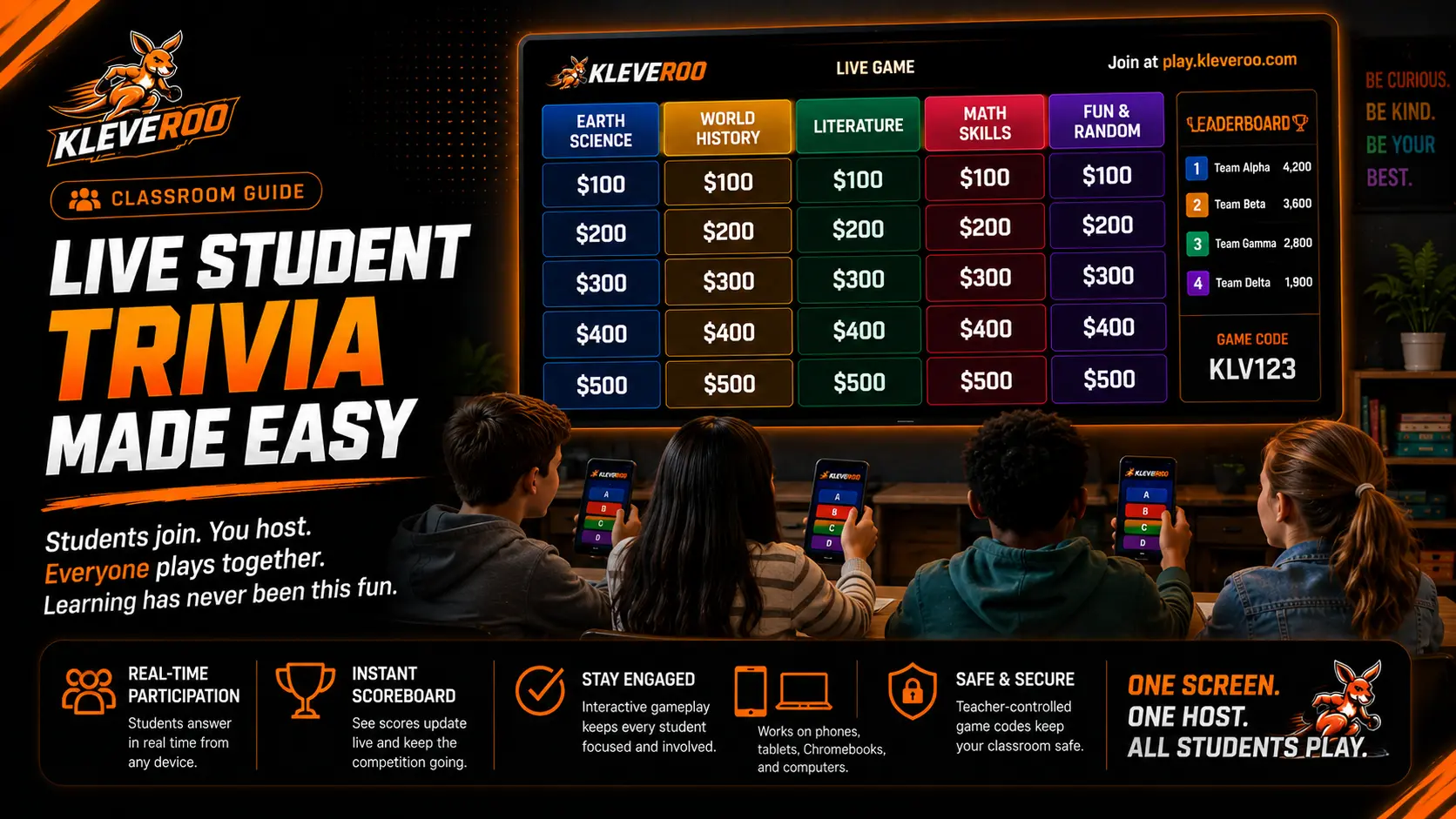
The closest match on play model. Board Battle is host-led on a shared screen, projector, TV, or screen share, with one host controlling the board, timer, scoring, and pace, and no participant devices required. That's the same classroom setup Baamboozle uses.
The difference is shape. A Jeopardy-style board with categories and point values is a slower, more structured game than a Baamboozle round — better suited to reviewing a full unit across several topics, less suited to a five-minute vocabulary warm-up. AI-assisted creation is available if writing clues by hand is the bottleneck, and public boards can be browsed and played before you create an account.
There's also Live Trivia as a separate mode where participants join from their own devices, for the occasions when you do want that.
Where Baamboozle is better: pace. If your use case is quick rounds rather than unit review, a board format is more machinery than you need.
JeopardyLabs — for a free tier with no ads and no signup
If the ads on Baamboozle's free plan are the specific problem, this is the direct answer. JeopardyLabs is free to create and play with no account required, ad-free on both its free and $20 lifetime tiers. Its browse page states 2 million games, searchable while logged out, and games can be downloaded and played offline in a browser.
The tradeoffs are real. There's no buzzer — the host awards points manually. There's no built-in Daily Double, Double Jeopardy, or Final round. The editor is always a 5×5 grid and the color scheme can't be changed without editing the downloaded file's code. And it declines to sign district legal agreements, which matters if yours requires one.
Also worth knowing: JeopardyLabs states it does not review games for accuracy, so preview anything from the library first. More detail in our guide to JeopardyLabs alternatives.
Factile — for buzz-in and formal game-show rounds
A step toward more structure rather than less. Buzzer Mode covers classroom and remote play, and Double Jeopardy and Daily Double are built in, with a documented final round using proper wagering.
The free tier allows 3 custom games and requires an account, and the buzzer and special rounds start on the paid plans: $48/year Basic, $72/year Plus, $90/year Business. AI creation is listed on their plans page as carrying an additional charge on top, with no figure published there. Their Home/School Basic tier is below Baamboozle's annual price; Plus and Business are above it.
Alongside the board there are Choice, Memory, Self-Paced, Flashcards, and Interactive Choice modes. More in Factile alternatives.
Side by side
| | Play model | Free tier | Paid entry | |---|---|---|---| | Baamboozle | Host-led, one screen, quick rounds | Ad-supported, 1 folder, public games only | $59.88/year | | Kleveroo | Host-led Board Battle on a shared screen; Live Trivia is a separate per-device mode | Browse and play public boards without an account | Paid tier for AI-assisted creation | | JeopardyLabs | Host-led board, host awards points manually | Full creation and play, no account, ad-free | $20 one-time | | Factile | Host-led board, buzz-in on paid tiers | 3 custom games, account required | $48/year |
When to stay
Stay on Baamboozle if:
- Your sessions are five to ten minutes of fast rounds, not full-period reviews
- You teach language and the team-talk dynamic is doing real work for you
- The free tier's limits haven't bitten yet, or $59.88 a year is easy to justify
- Your students already know the format and it runs itself
Switching to a board format for a use case that wants quick rounds is a downgrade dressed as an upgrade. The structure that helps a unit review gets in the way of a warm-up.
A middle path
You don't have to replace one tool with another. Quick rounds in one and structured unit review in another is a workable split, and since several options here have free tiers or no-signup access, running both costs little.
If you want to try the board format alongside what you already use, Kleveroo's public boards can be played before you make an account, and the Jeopardy board maker is free to build in.
For the classroom mechanics of running any host-led game well, see whole-class games that work without 1:1 devices and our guide to classroom review games for any subject.