
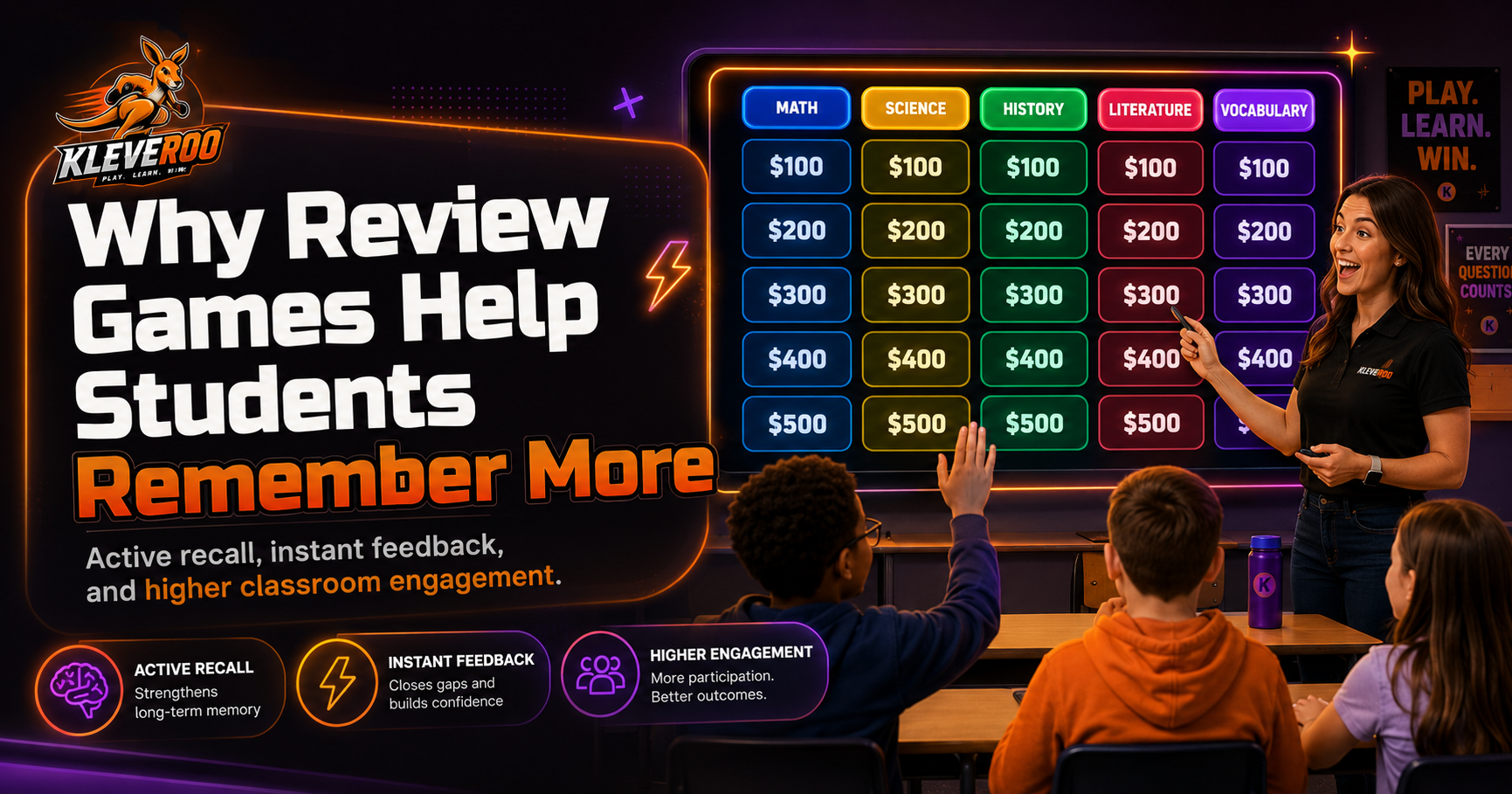
Review games beat worksheets before a test mainly because of volume and participation. A twenty-minute game gets every student attempting recall dozens of times, out loud, with instant correction. A worksheet gets each student one silent pass through the same questions, and the corrections often arrive the next day — after the test. Worksheets still have real advantages, which is why the honest answer is not "games always win" but "use each one for what it is good at."
What a Review Game Does That a Worksheet Cannot
- More retrieval attempts per minute. Every clue is a memory test for the whole room, not just for the student whose turn it is.
- Immediate correction. Wrong answers get fixed while there is still time to relearn, instead of coming back marked in red after the exam.
- Participation from students who do not finish packets. Team play pulls in students who quietly opt out of individual written work.
- Discussion. Teams argue their way to an answer, which forces them to explain reasoning aloud — a stronger form of processing than filling a blank.
- A visible weak-spot map. The categories the class stalls on tell you exactly what to reteach tomorrow morning.
What Worksheets Are Still Better For
A review game is a poor substitute for written practice when the test itself is written. Keep worksheets when you need:
- evidence of each student's individual work rather than their team's
- extended responses, showing work, or multi-step problems
- a quiet diagnostic you can grade and act on
- something students can take home and redo
- a calm task on a day when the class cannot handle competition
The strongest pre-test sequence usually uses both: a worksheet or practice set to surface gaps two or three days out, then a review game the day before to hammer the items students got wrong.
Why the Difference Comes Down to Retrieval
Both formats can create retrieval practice — the act of pulling an answer out of memory, which strengthens the memory more than rereading it does. The game simply creates far more of it in the same amount of class time, and adds the feedback loop immediately. We cover the underlying evidence in more depth in why game-based learning improves retention.
This also explains the most common failure mode. A review game built from easy recognition questions feels successful — students are loud, engaged and correct — while producing almost no memory gain. Difficulty is the ingredient, not the noise.
How to Run a 20-Minute Pre-Test Review Game
- Pull your five weakest topics from the unit. Not five even topics — five weak ones. Those become your categories.
- Write five clues per category, easy to hard. Match the phrasing of your actual test questions so the retrieval transfers.
- Split into teams of three to five and appoint yourself host so scoring stays uncontested.
- Set a clue timer — twenty to thirty seconds keeps pace without panic.
- Rotate the answerer so one confident student cannot carry the table.
- Say the why after every reveal. Ten seconds of explanation is where the relearning happens.
- Note every clue that stalled the room and open tomorrow's class with those three items.
You can build this in a few minutes with the free Jeopardy board maker, have the AI board generator draft it from your unit topic and edit the clues, or start from an existing board in the board library.
Running It Without Student Devices
A shared-screen review game needs one classroom display and one host. Students play in teams from their seats, the board tracks scores and marks played clues automatically, and there is no join code, no login and no cart to charge. That matters on review day, when the last thing you want to spend five minutes on is device troubleshooting. More options in whole-class games without devices.
The Honest Comparison
| Review game | Worksheet | |
|---|---|---|
| Retrieval attempts per student | High | Moderate |
| Feedback speed | Immediate | Usually delayed |
| Individual accountability | Low | High |
| Written practice | None | Yes |
| Participation | Whole class | Varies widely |
| Prep time | 10-20 min (or minutes with AI) | Low if reused |
| Best used | Day before the test | Two to three days out |
The Takeaway
Worksheets tell you what students cannot do yet. Review games are how you fix it before the test. Use the packet to diagnose, and use the game to practise — loudly, repeatedly, and with the answer explained every single time.