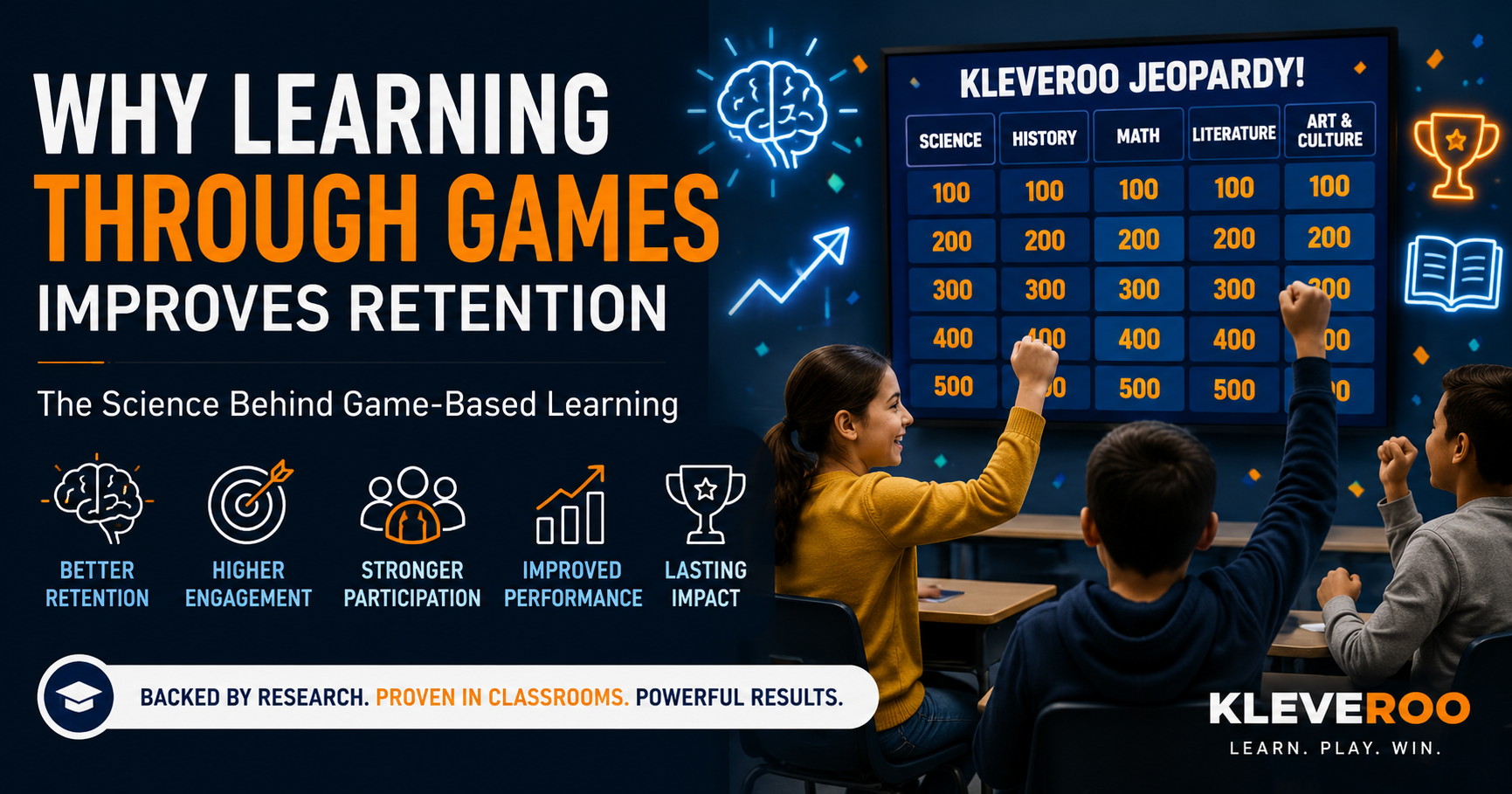
Game-based learning improves memory and retention because it forces learners to retrieve information rather than reread it. Every clue answered is an act of retrieval practice, and each retrieval strengthens the memory it pulls from. Games add three more things that help: immediate feedback, so errors get corrected while the material is still active; repetition of key ideas across different questions; and heightened attention, which improves how well information is encoded in the first place. That combination is why a review game often sticks when a re-read does not.
What Is Game-Based Learning?
Game-based learning is the use of an actual game — a quiz board, a trivia round, a simulation — as the learning activity itself. It is different from gamification, which adds game elements such as points, timers, badges or leaderboards to an activity that is not otherwise a game.
A Jeopardy-style review board played before a test is game-based learning. Awarding badges for completing a worksheet is gamification. Most classroom and training platforms do a bit of both.
Does Game-Based Learning Improve Retention?
In most studies, yes — though the size of the effect depends heavily on how the game is designed. The consistent finding across the literature is that game-based learning improves engagement and motivation, and that it improves learning outcomes when the game itself requires learners to produce answers from memory.
A game that asks learners to click through content without recalling anything does not produce the same benefit. The active ingredient is retrieval, not the game wrapper.
What Does the Research Say About Game-Based Learning?
A 2020 meta-analysis published in Educational Psychology Review examined gamification and learning outcomes and found that game-based elements positively impacted learning performance, motivation and engagement across educational settings.
A 2024 meta-analysis published in Computers & Education Open found that both serious games and gamification had a positive effect on learning achievement and motivation, with gamification showing especially strong effects on motivation.
A 2023 meta-analysis focused on STEM education reported improvements in cognition, motivation and classroom behaviour among early STEM learners.
A 2025 study published in Education Sciences found that game-based learning enhanced student engagement, self-efficacy and knowledge retention across multiple disciplines, including biology and architecture.
A 2024 longitudinal study on knowledge retention found that learners maintained strong performance one year after game-based training, with no statistically significant decline in test performance over that period.
Taken together: the evidence for engagement and motivation is strong and consistent, and the evidence for retention is positive but more variable across study designs. Full references are listed at the end of this article.
Why Do Games Help People Remember Information?
Four mechanisms do most of the work.
- Attention. People remember what they attend to. Competition, urgency and curiosity keep attention on the material longer than passive review does, and attention drives encoding.
- Retrieval. Each clue is a memory test, and testing strengthens memory.
- Feedback. Learners find out immediately whether they were right, so wrong answers are corrected before they harden.
- Repetition with variation. The same concept can appear in several clues phrased differently, which builds flexible recall rather than memorised wording.
How Does Retrieval Practice Improve Memory?
Retrieval practice is the act of pulling information out of memory rather than putting it back in. Cognitive psychology research has repeatedly found that learners who are tested on material remember more of it later than learners who spend the same time rereading it.
The effort matters. Recall that is slightly difficult but successful produces the strongest gains, which is why review games work best when the questions are not trivially easy. If a class is answering everything correctly and instantly, the game is pleasant but it is no longer building much memory.
Why Do Jeopardy-Style Review Games Work?
Jeopardy-style games happen to bundle several evidence-based strategies into a single format:
- Retrieval practice — every clue requires an answer from memory.
- Immediate feedback — the answer is revealed seconds later.
- Spaced repetition within a session — key ideas recur across categories and point values.
- Graduated difficulty — point values give a built-in easy-to-hard progression.
- Social learning — teams discuss and explain, which is itself a form of elaboration.
- Emotional engagement — friendly competition increases focus.
You can see the format in practice in Kleveroo's free board library, or build one for your own material with the Jeopardy board maker.
Does Game-Based Learning Work for Adults?
Yes. Retrieval practice, feedback and spacing are properties of human memory, not of school age. Game-based review is used in employee onboarding, product and sales training, compliance refreshers, workshops and all-hands meetings for the same reason it is used before a unit test: people forget what they only heard once.
The practical difference with adults is tone and time. Adult sessions are usually shorter, run on a shared screen in a meeting or on a video call, and work best when the content is genuinely job-relevant rather than generic trivia. See office Jeopardy for workplace formats.
How to Use Games to Improve Learning and Retention
- Pick 8–12 target facts or skills. Fewer items, retrieved more often, beats broad coverage retrieved once.
- Write questions that require production, not recognition. "Name three causes of X" beats "Which of these is a cause of X?"
- Grade the difficulty. Start with cued recall and move to free recall as the session goes on.
- Give the answer immediately, and explain it. The explanation is where the relearning happens.
- Space the sessions. Three ten-minute games across two weeks outperform one thirty-minute game the night before.
- Reuse and refine. Keep the clues that trip people up and rotate out the ones everyone answers instantly.
To put this into practice, build a board manually or let the AI board generator draft one from your topic or your own material, then edit the clues before you play.
The Takeaway
Games help learning stick not because they are fun, but because a well-built game is a retrieval machine. Fun is what makes learners willing to do the retrieval over and over.
References
- Sailer, M., & Homner, L. (2020). The Gamification of Learning: A Meta-analysis. Educational Psychology Review.
- Ren, J. et al. (2024). The Impact of Educational Games on Learning Outcomes. Computers & Education Open.
- Arztmann, M. et al. (2023). Effects of Games in STEM Education: A Meta-analysis on Cognition, Motivation and Behavior.
- Seddighi-Khavidak, S. et al. (2025). Game-Based Learning Enhances Engagement and Knowledge Retention. Education Sciences.
- Kanade, S. et al. (2024). Evaluating the Effectiveness of Game-Based Learning for Long-Term Knowledge Retention.