
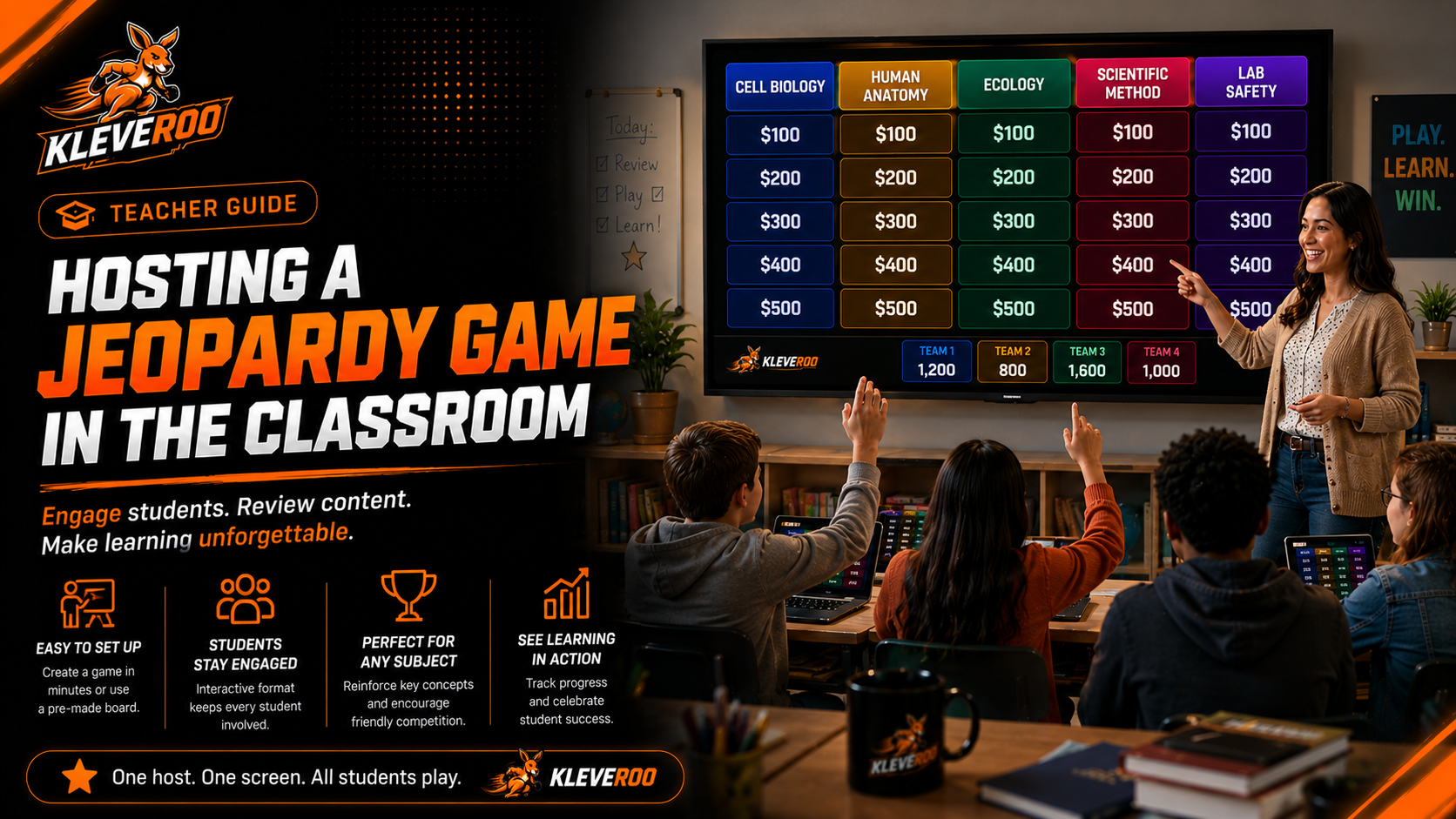
Building the board takes twenty minutes. Running it well takes a set of rules you decide before the period starts, because you can't invent scoring policy while 28 students argue about a steal.
This covers the mechanics: board setup, team formation, scoring, timing, and the participation problem that sinks most first attempts.
Board setup
Size. Five categories with five clues each is the standard, giving 25 clues. That's a reasonable amount for a 45- to 50-minute period once you account for setup and discussion. For a 30-minute slot, use four categories with four clues.
Point values. Whatever scale you use, the values should reflect real difficulty. A board where the 500-point clue is no harder than the 100 teaches students to ignore the numbers. Build the column as a genuine ladder: recall at the bottom, application in the middle, multi-step or synthesis at the top.
Category naming. Plain names beat clever ones. "Cell Structures" is more useful to a reviewing student than "Tiny Worlds." The board is a study aid as well as a game; students who can read the categories can predict what's on the test.
Answer format. The television program uses a question format. In a classroom this is optional and often just adds a rule to enforce mid-game. Decide before you start and tell the class. Many teachers skip it.
Forming teams
How many. Five or six teams for a class of 25 to 30. With fewer, teams wait a long time between turns. With more, each team gets too few turns to stay invested.
How to form them. Mixed ability, chosen by you. Student-chosen teams tend to cluster the strongest students together, the game becomes a rout by the halfway point, and everyone else stops trying. If you want speed, count off by five and adjust two or three placements quietly.
Naming. Give teams thirty seconds to pick a name and enforce the limit. Left open-ended this can consume most of the setup time.
Seating. Teams need to sit together and talk quietly. If your room can't accommodate that, assign rows as teams rather than trying to reorganize furniture mid-period.
Turn order and board control
Two workable models:
Fixed rotation. Teams take turns in a set order regardless of outcomes. Predictable, easy to track, and every team knows when their turn is coming.
Winner picks. The team that answers correctly chooses the next clue. Adds strategy and rewards success, but a strong team can dominate board selection. Cap it: no team picks twice in a row.
For a first attempt, use fixed rotation. It removes a whole category of disputes.
Scoring rules to decide in advance
Correct answer. Team gains the clue's value.
Incorrect answer. Decide between three options and stick to it:
- No penalty. Simplest. Teams guess freely, which keeps pace up but reduces the cost of not thinking.
- Lose the value. Mirrors the television scoring and makes teams deliberate. Can produce negative scores, which younger students often take badly.
- No penalty, but the turn passes. The middle option and the one many classrooms end up at.
Steal. When a team misses, the next team in rotation may attempt it. This is the most valuable rule on the list, because it's what makes teams listen during other teams' turns. Without it, four teams can tune out for most of the game.
Time limit. Fifteen to twenty seconds for recall clues, thirty to forty-five for multi-step problems. Announce the limit and hold to it. A visible timer does more for pacing than anything you can say.
The participation problem
This is the difference between a review and a spectator sport.
In a standard board game, one team answers at a time. With five teams, any given student's team is answering roughly a fifth of the clues. The rest of the time they are watching, and watching is not reviewing.
The fix is one rule: every student writes an answer before the answering team responds.
How it runs:
- Clue appears.
- Every student in the room writes an answer on paper or a mini whiteboard.
- The answering team confers and responds.
- Correct answer revealed. Students check their own.
It costs about ten seconds per clue, roughly four minutes across a full board. In exchange, every student attempts all 25 clues instead of five. Collect the papers at the end and you have a rough read on who knew what, which is usually the reason you ran the review in the first place.
Rotating who speaks
Without a rule, one student tends to answer every clue for their team. Number each team's members and require that the student whose turn it is gives the answer, after the team confers.
The team can still discuss. The strongest student can still contribute. But the answer comes out of a different mouth each turn, which spreads both the pressure and the practice.
Timing a 25-clue board
A workable budget for a 50-minute period:
| Segment | Time | |---|---| | Team formation and rules | 5 min | | 25 clues at roughly 60-75 seconds each | 30 min | | Final question | 5 min | | Reviewing missed clues | 8 min |
That last block is not optional filler. The clues the class got wrong are the actual output of the session. If you run out of time and skip it, you played a game and learned nothing you can act on.
If you're running short, cut clues rather than cutting the review at the end.
A final question
A single closing question that teams wager on before seeing it changes the ending significantly. Teams that are behind can catch up, which helps keep the whole room engaged through the last ten minutes rather than mentally checking out once the outcome looks decided.
Mechanics: each team writes a wager up to their current score, sees the question, writes an answer, then both are revealed together. Teams with zero or negative scores wager nothing.
Some platforms handle wagering, scoring, and timing for you; others expect you to run it manually. If yours doesn't support wagers, index cards work fine.
Common problems
One team runs away with it. Steal rules and a wagered final question both help. So does a board where the high-value clues are genuinely hard, since a strong team that clears the easy column early hasn't actually locked anything up.
Arguments about answer correctness. Decide in advance that the host's ruling stands, say so at the start, and don't reopen it. Note genuinely ambiguous clues and fix them before next year.
The game gets loud. Expected and mostly fine. If it becomes unworkable, a rule that a team forfeits its turn if anyone shouts out during another team's clue usually resolves it within a couple of turns.
Time runs out mid-board. Total the scores where they are. Most classes don't mind. Do not skip the review of missed questions to finish the board.
Building the board
You can build one from scratch or start from an existing board and rewrite the clues, which is faster for a first attempt. Kleveroo's Jeopardy board maker gives the host control of the board, timer, and scoring during play, and there are alternatives compared in our roundup of Jeopardy game makers. If you're moving off a slide-deck template, running a Jeopardy game without PowerPoint covers that transition.
For the room-level constraints — one screen, no student devices — see whole-class games that work without 1:1 devices. For choosing between this and other review formats, see classroom review games for any subject.